
When sourcing brake pads, most buyers compare prices, certifications, and delivery timelines. But one critical question often remains unanswered:
What actually happens inside the factory before a brake pad reaches your warehouse?
At Supreme Sales Agency, we believe trust is built through transparency. Every high-quality brake pad is the result of a carefully controlled manufacturing process, precision engineering, and rigorous quality inspections—not just a finished product in a box.
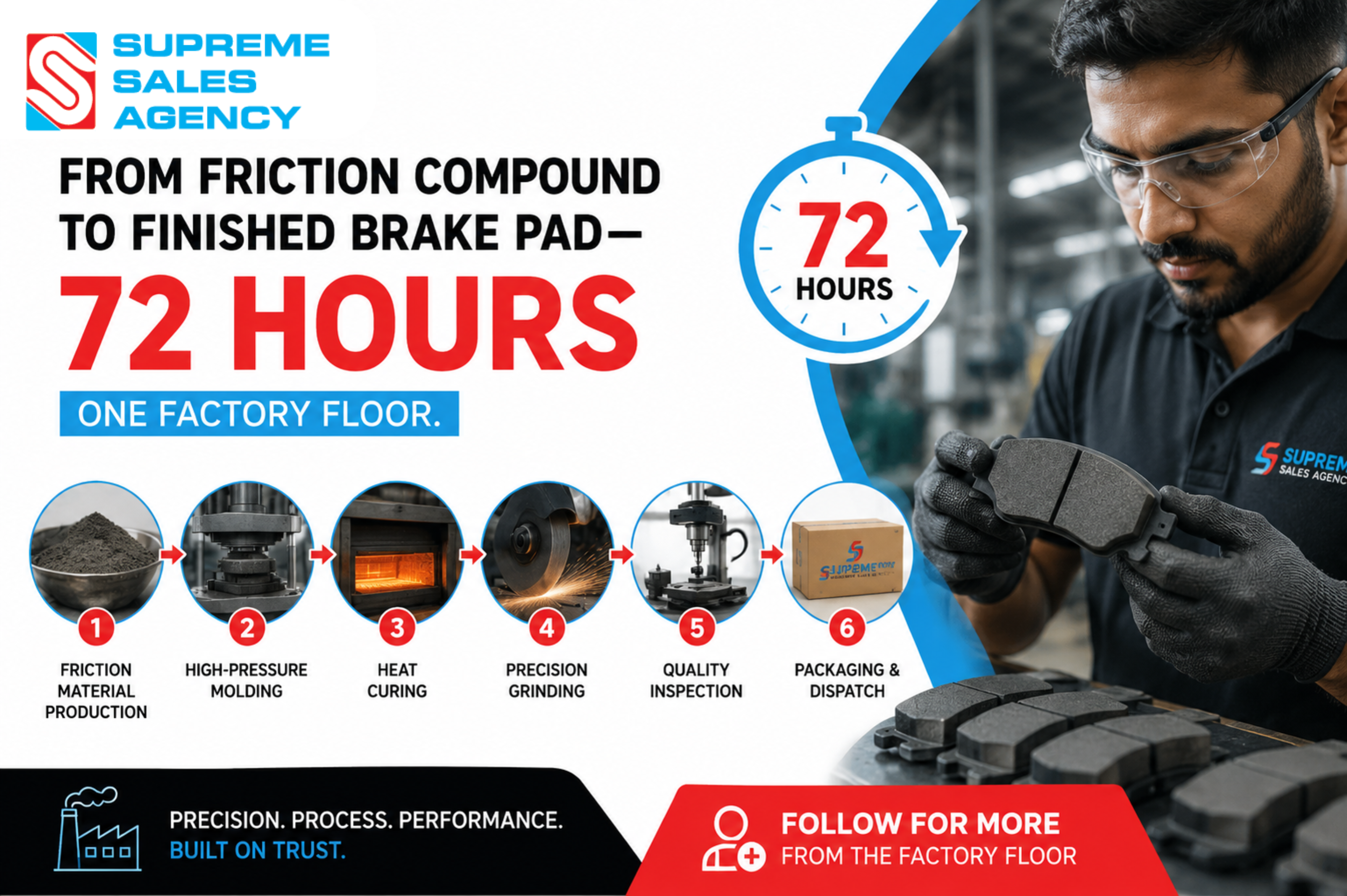
In fact, from the preparation of the friction compound to the final inspection, the complete brake pad manufacturing process in India can be completed in as little as 72 hours on a modern production floor. Here's a closer look at the journey.
Step 1: Precision Friction Material Production
Every brake pad starts with its heart—the friction material.
The performance of a brake pad depends largely on the composition of its friction compound. Manufacturers carefully blend a combination of fibers, fillers, friction modifiers, binders, abrasives, and lubricants to create a balanced formula that delivers reliable stopping power, reduced noise, and long service life.
Modern friction material production relies on automated weighing and mixing systems to maintain consistency in every batch. Even small variations can affect braking performance, making strict process control essential.
For OEM and aftermarket buyers, this stage determines the overall reliability and consistency of every brake pad supplied.
Step 2: High-Pressure Molding
Once the friction compound is prepared, it is transferred into precision molds along with the steel backing plate.
Using hydraulic presses, the material is compressed under carefully controlled pressure and temperature. This forms the brake pad into its required dimensions while ensuring proper bonding between the friction material and the backing plate.
Accuracy during molding helps ensure:
- Uniform density
- Consistent braking performance
- Reduced vibration
- Better durability
This stage lays the structural foundation for every finished brake pad.
Step 3: Heat Curing for Maximum Strength
Freshly molded brake pads are not yet ready for the road.
They undergo a controlled curing process inside industrial ovens, where high temperatures activate the resin binders within the friction material.
This curing cycle strengthens the pad, stabilizes its structure, and improves heat resistance during braking.
Proper curing is one of the most important quality checkpoints in the brake pad manufacturing process in India, ensuring that every pad performs consistently under demanding driving conditions.
Step 4: Precision Grinding and Finishing
After curing, every brake pad is machined to achieve exact dimensional accuracy.
Grinding machines remove excess material while ensuring the pad thickness remains within strict tolerances. Modern factories also add chamfers and slots that help reduce braking noise and improve heat dissipation.
Surface finishing ensures proper contact with the brake disc, resulting in smoother braking performance from the very first installation.
Step 5: Quality Inspection at Every Stage
Manufacturing excellence isn't just about production speed—it's about inspection.
Every batch undergoes multiple quality control checks before packaging.
These inspections commonly include:
- Dimensional accuracy testing
- Bond strength verification
- Density measurements
- Friction coefficient testing
- Hardness testing
- Visual inspection
- Noise and vibration evaluation
Many manufacturers also perform dynamometer testing to simulate real-world braking conditions before approving production batches.
For procurement teams, these quality assurance processes provide confidence that every shipment meets consistent performance standards.
Step 6: Final Packaging and Dispatch
Only after passing quality inspections are brake pads cleaned, labeled, packaged, and prepared for shipment.
Proper packaging protects the products from moisture, contamination, and transportation damage while ensuring easy identification and traceability throughout the supply chain.
Within approximately 72 hours, raw materials have been transformed into precision-engineered brake pads ready for OEM and aftermarket distribution.
Why Manufacturing Transparency Matters to Buyers
Many suppliers make performance claims, but experienced buyers know that quality starts long before the final product reaches the warehouse.
Understanding the manufacturing process helps procurement teams evaluate suppliers based on more than price alone.
A transparent manufacturing process demonstrates:
- Consistent production standards
- Reliable quality control
- Process repeatability
- Better product performance
- Reduced warranty risks
- Long-term supplier credibility
When buyers can visualize the production journey, trust becomes easier to build.
Supreme Sales Agency: Delivering Confidence Beyond the Product
At Supreme Sales Agency, we understand that purchasing decisions are built on confidence.
That's why we focus not only on supplying dependable brake components but also on sharing the manufacturing knowledge behind every product. Our commitment to quality, consistency, and transparency helps OEM and aftermarket buyers make informed sourcing decisions with greater confidence.
Whether you're managing large procurement volumes or sourcing replacement brake components for diverse vehicle segments, understanding the manufacturing process enables smarter supplier evaluation and stronger long-term partnerships.
Final Thoughts
A brake pad may appear simple, but its journey from carefully engineered friction material to a finished product involves precision, science, and rigorous quality control at every step.
The next time you evaluate a supplier, don't just ask about certifications or pricing. Ask about the manufacturing process, quality checks, and production standards behind every brake pad.
Because trust isn't built through claims—it's built through consistent manufacturing excellence.
Follow Supreme Sales Agency for more insights from the factory floor, where quality, precision, and innovation come together to power safer braking solutions.