
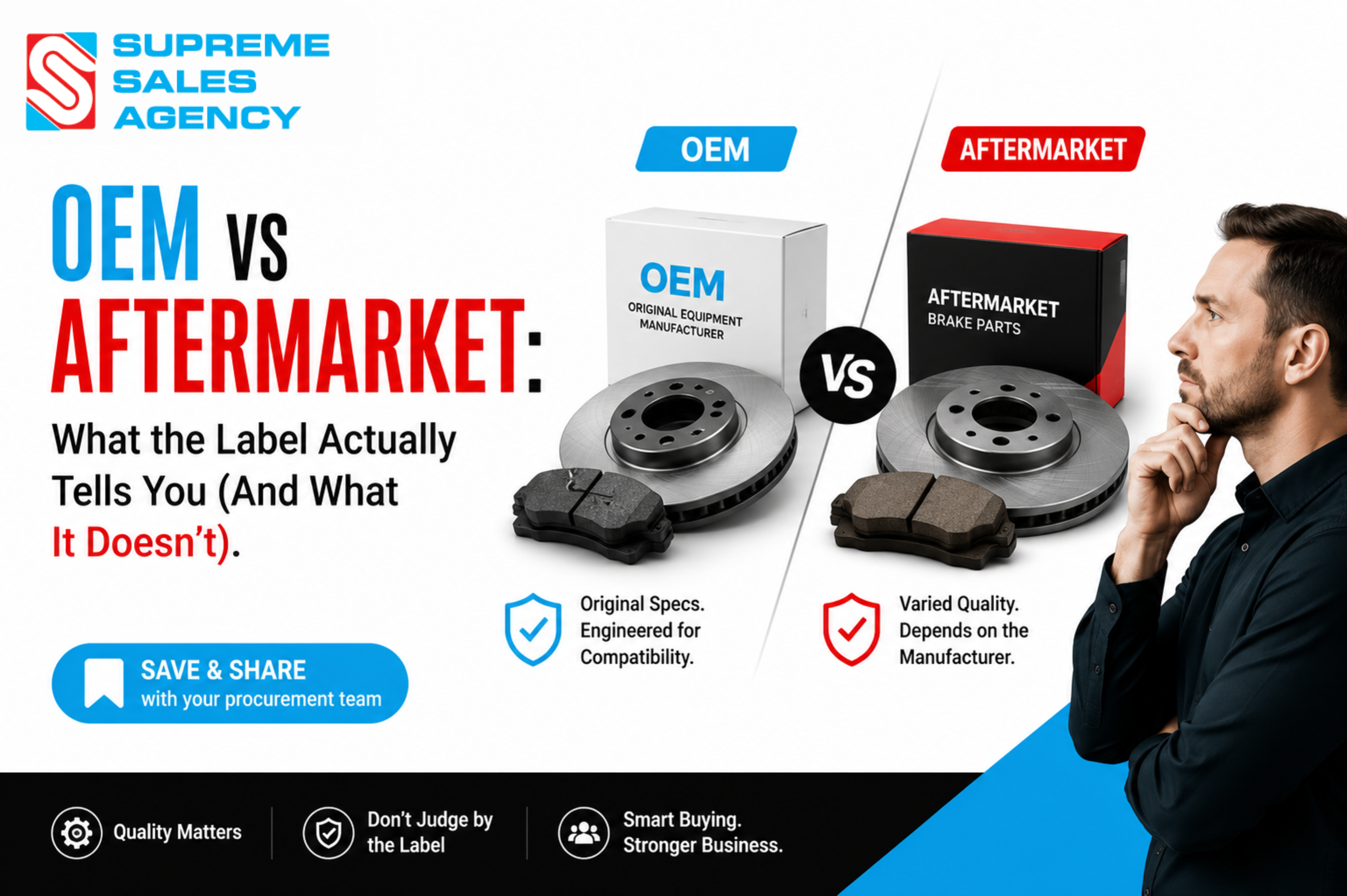
When sourcing automotive components, one of the most common questions buyers ask is: Should we choose OEM or aftermarket brake parts?
For many trading houses and wholesale distributors, the assumption is simple—OEM automatically means better quality, while aftermarket parts are often seen as the cheaper alternative. But the reality is far more nuanced.
Understanding the difference between OEM vs aftermarket brake parts is essential for making smarter purchasing decisions, reducing warranty claims, and delivering consistent value to customers. At Supreme Sales Agency, we believe informed buyers make better long-term business decisions, and this starts with understanding what these labels truly represent.
What Does OEM Actually Mean?
OEM stands for Original Equipment Manufacturer. These are parts manufactured according to the specifications used in a vehicle's original production.
However, an OEM label primarily indicates compatibility and specification, not necessarily superior quality compared to every aftermarket alternative. In many cases, the same manufacturing facilities produce both OEM and aftermarket components under different branding and quality standards.
The OEM designation tells you where the design originated—not that it is the only reliable option available.
Understanding Aftermarket Parts
The term "aftermarket" covers a broad spectrum of products manufactured by companies other than the original vehicle manufacturer.
This is where confusion often begins.
Not all aftermarket brake parts are created equal. The market includes:
- Premium aftermarket manufacturers with strict quality control
- OE-equivalent replacement parts
- Performance-oriented brake components
- Budget-focused products with varying quality standards
This is why aftermarket parts quality explained cannot be reduced to a single statement. Quality depends on the manufacturer, engineering standards, materials, testing processes, and certifications—not simply the aftermarket label.
Why the Label Alone Doesn't Guarantee Quality
One of the biggest procurement mistakes is relying solely on the product label.
Instead, experienced buyers evaluate multiple factors, including:
- Manufacturing quality standards
- Raw material specifications
- Precision machining
- Heat treatment processes
- Performance testing
- Product certifications
- Supplier consistency
- Warranty support
A premium aftermarket brake pad that meets international standards may outperform a lower-quality OEM replacement in specific applications.
Likewise, not every aftermarket product offers the same reliability. Due diligence remains essential regardless of the branding.
What Smart Procurement Teams Actually Evaluate
Professional distributors and trading houses increasingly focus on measurable performance rather than labels alone.
Before finalizing suppliers, consider asking:
- Does the manufacturer maintain consistent production quality?
- Are the brake parts tested for durability and safety?
- Are international quality certifications available?
- Is the supplier capable of maintaining inventory consistency?
- What is the warranty history?
- How responsive is the supplier when issues arise?
These questions reveal much more than simply asking whether a product is OEM or aftermarket.
The Business Impact of Choosing Wisely
Selecting reliable brake components affects more than product performance.
Better sourcing decisions help:
- Reduce product returns
- Lower warranty costs
- Increase customer satisfaction
- Build distributor credibility
- Improve long-term profitability
- Strengthen dealer relationships
For wholesale businesses handling large volumes, even a small improvement in product consistency can significantly reduce operational costs.
The Growing Strength of Quality Aftermarket Auto Parts
Today's automotive aftermarket has evolved dramatically.
Many leading manufacturers invest heavily in:
- Advanced engineering
- Automated manufacturing
- Quality assurance systems
- International compliance
- Continuous product improvement
As vehicle technology advances, reputable aftermarket suppliers continue to innovate, offering solutions that meet or exceed industry expectations across multiple vehicle segments.
This is why more procurement professionals now evaluate suppliers based on performance, consistency, technical support, and reliability instead of relying solely on OEM branding.
How Supreme Sales Agency Helps Buyers Make Smarter Decisions
At Supreme Sales Agency, we understand that every procurement decision impacts your business reputation.
Rather than promoting products based on labels alone, we emphasize:
- Consistent product quality
- Trusted manufacturing partnerships
- Reliable supply chain support
- Technical product knowledge
- Competitive wholesale solutions
- Long-term distributor relationships
Our goal is to help trading houses and wholesale distributors source automotive components with confidence, backed by transparency and dependable service.
Final Thoughts
The debate around OEM vs aftermarket brake parts isn't about deciding which label is universally better—it's about understanding what each label actually represents.
Smart buyers don't purchase based on assumptions. They evaluate manufacturing quality, supplier credibility, certifications, consistency, and long-term value.
In today's competitive automotive aftermarket, informed procurement decisions create stronger businesses.
When you focus on quality instead of labels, you don't just buy better parts—you build greater trust with every customer you serve.
Save this article and share it with your procurement team to help everyone make smarter, more informed sourcing decisions.