
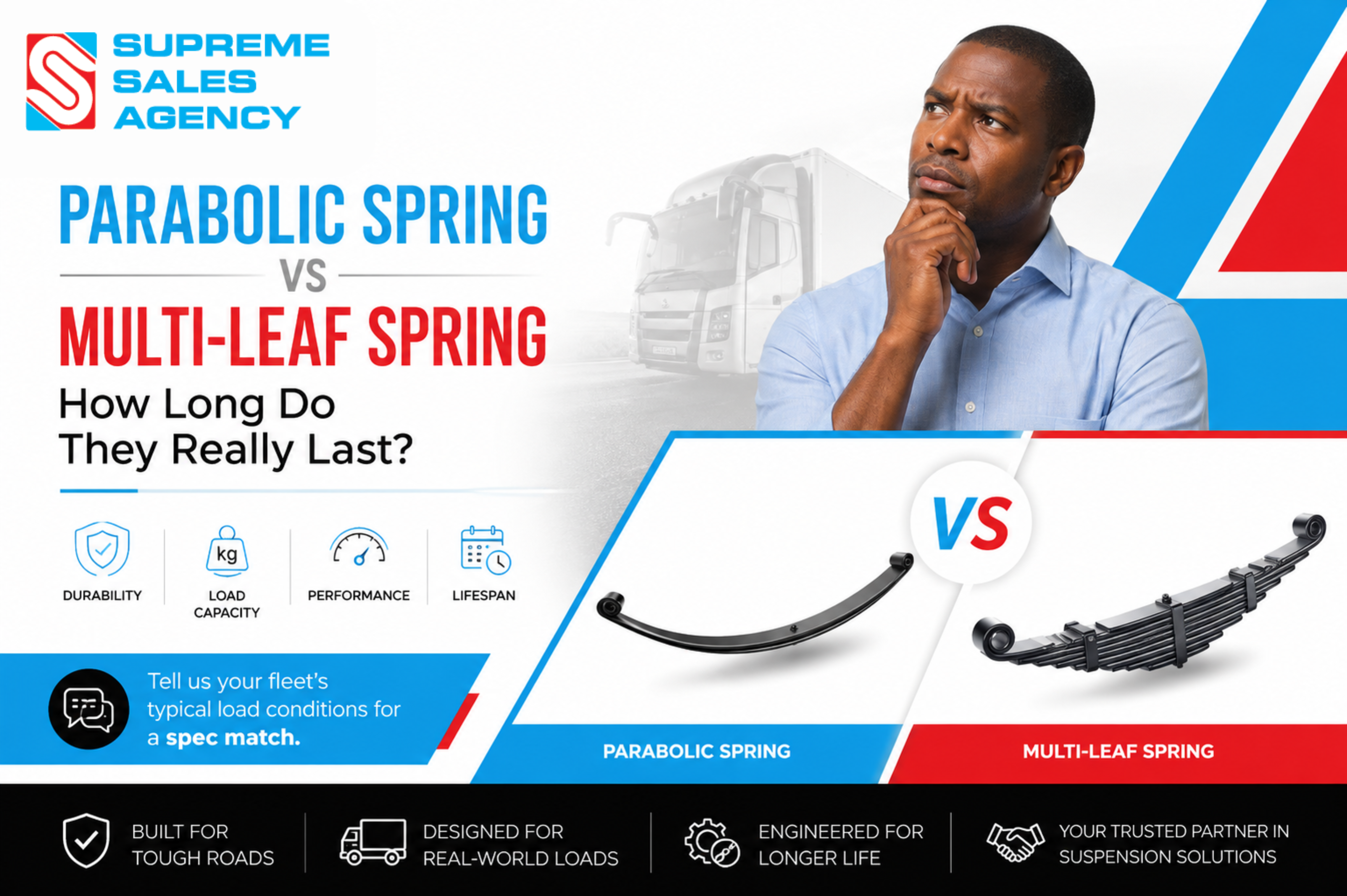
When buyers ask, "How long do parabolic springs last vs multi-leaf springs?", they're usually expecting a simple number. The truth is, there isn't one.
The lifespan of any leaf spring depends less on the spring itself and more on how well it matches the vehicle's operating conditions. A perfectly engineered spring can fail early if it's used in the wrong application, while the right specification can deliver years of dependable performance.
For fleet owners, distributors, and import managers across Africa and the Middle East, choosing between a parabolic spring vs multi leaf spring isn't just about durability—it's about selecting the right suspension solution for the job.
At Supreme Sales Agency, we help customers match suspension components to real-world operating conditions instead of relying on assumptions.
Understanding the Difference
Both parabolic and multi-leaf springs are designed to support vehicle weight, absorb road shocks, and improve ride stability. However, they are built differently and serve different purposes.
Parabolic Leaf Springs
Parabolic springs use fewer leaves, with each leaf tapered from the center toward the ends. This design reduces friction between leaves, making the suspension lighter and more flexible.
Key advantages include:
- Improved ride comfort
- Reduced vehicle weight
- Better fuel efficiency
- Lower interleaf friction
- Smoother handling on highways and paved roads
These springs are commonly used in light commercial vehicles, buses, pickups, and fleets operating with relatively consistent loads.
Multi-Leaf Springs
Multi-leaf springs consist of several steel leaves stacked together to distribute heavy loads evenly. Their robust construction makes them the preferred choice for demanding commercial applications.
Benefits include:
- Higher load-carrying capacity
- Excellent durability under continuous heavy loads
- Better resistance to overloading
- Proven reliability in harsh operating environments
- Easier servicing in heavy-duty fleets
Heavy trucks, trailers, construction vehicles, mining equipment, and agricultural transport typically rely on multi-leaf spring suspension systems.
So, Which Lasts Longer?
The honest answer is:
The correctly specified spring always lasts longer than the wrong one.
There is no universal winner in the parabolic spring vs multi leaf spring debate.
For example:
A truck transporting construction materials every day on rough roads may quickly wear out a parabolic spring because it wasn't designed for constant heavy loading.
On the other hand, a delivery fleet running mostly on highways with moderate payloads may experience unnecessary wear, higher fuel consumption, and a rough ride by using heavy multi-leaf springs where lighter parabolic springs would have been more suitable.
In both cases, incorrect specification—not product quality—is the real issue.
Factors That Affect Leaf Spring Lifespan
Several operating conditions directly influence leaf spring lifespan.
Vehicle Load
Constant overloading is one of the biggest causes of premature suspension failure. Springs should always be selected based on average working loads rather than occasional peak loads.
Road Conditions
Vehicles operating on rough terrain, gravel roads, mining sites, or uneven surfaces experience significantly greater suspension stress than highway fleets.
Driving Style
Frequent hard braking, aggressive acceleration, and high-speed operation over rough roads increase fatigue in suspension components.
Material Quality
High-grade spring steel, precision heat treatment, and strict manufacturing standards play a major role in extending service life. Premium-quality commercial vehicle parts deliver more consistent long-term performance.
Maintenance
Regular inspection of U-bolts, shackles, bushings, and suspension hardware helps prevent uneven loading and unnecessary stress on the leaf spring assembly.
Choosing Based on Application, Not Assumptions
For importers and distributors, selecting the right truck suspension parts means understanding how the fleet actually operates.
Choose parabolic springs when:
- Ride comfort is important
- Vehicles carry moderate and consistent loads
- Fuel efficiency is a priority
- Highway driving is common
Choose multi-leaf springs when:
- Vehicles carry heavy loads daily
- Operating conditions are rough
- Durability is more important than ride comfort
- Fleets work in mining, construction, agriculture, or long-haul freight
The most successful fleet operators don't buy the strongest spring—they buy the right spring.
Why Proper Specification Saves Money
Many suspension failures begin with one mistake: choosing parts based only on dimensions or price.
Matching the correct leaf spring, truck suspension system, and commercial vehicle spare parts to actual operating conditions reduces:
- Premature spring failure
- Increased tyre wear
- Suspension maintenance costs
- Vehicle downtime
- Unexpected replacement expenses
A properly specified suspension system improves reliability, safety, and overall fleet profitability.
Partner with Experts Who Understand Your Market
At Supreme Sales Agency, we believe every fleet deserves a suspension solution designed around its real operating conditions—not guesswork.
Whether you're importing leaf springs, truck suspension components, heavy-duty auto parts, or other commercial vehicle spare parts, our team helps distributors select specifications that deliver the right balance of durability, performance, and value.
Choosing the right spring today can save thousands in maintenance and downtime tomorrow.
Tell Us About Your Fleet
Every fleet is different.
What are your vehicles carrying most of the time—light, medium, or heavy loads? Are they operating mainly on highways, urban roads, or rough terrain?
Share your fleet's typical load conditions in the comments, and the experts at Supreme Sales Agency will help you identify the most suitable leaf spring specification for your application.