
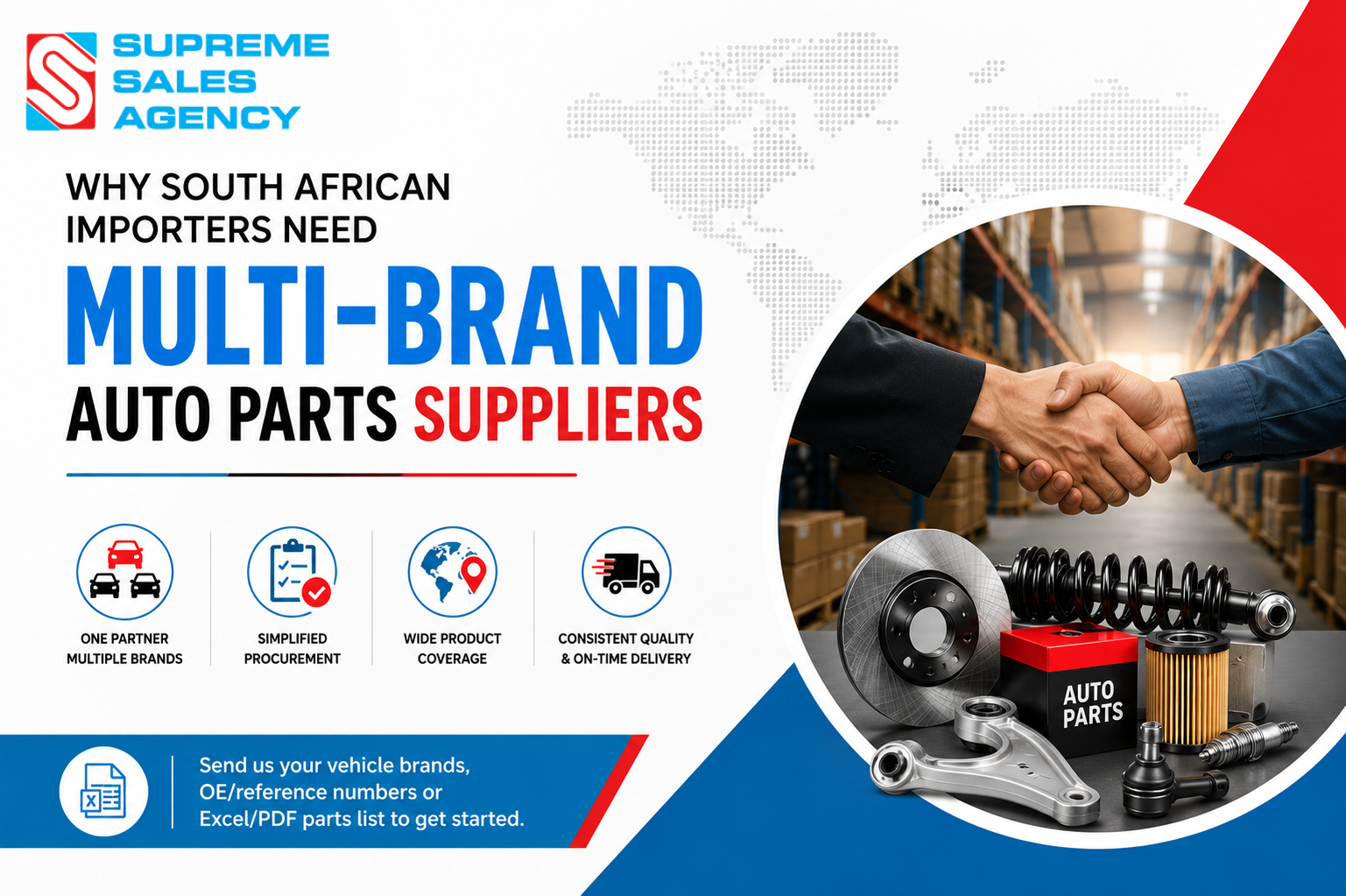
For many automotive parts importers, sourcing does not involve just one vehicle brand or one product category. A typical requirement may include parts for passenger cars, commercial vehicles, two-wheelers and three-wheelers, with hundreds of OE numbers and references across multiple applications.
Managing these requirements through separate suppliers can quickly become complicated. Different quotations, lead times, minimum order quantities, packaging standards and shipping arrangements can create unnecessary procurement work.
This is why working with a multi-brand auto parts supplier can offer a more practical sourcing model. Instead of managing multiple disconnected supplier relationships, importers can work with one sourcing partner to coordinate requirements across different vehicle brands and product categories.
For South African importers, Supreme Sales Agency (SSA) can work from OE numbers, aftermarket references, vehicle applications or an existing Excel/PDF parts list to help structure the sourcing requirement from the start.
The Challenge of Managing Multiple Suppliers
Importing auto parts for multiple vehicle brands often means dealing with several manufacturers or exporters.
An importer may need one supplier for engine components, another for suspension parts and another for filters, brake products or electrical components. Each supplier may have different:
· Minimum order quantities
· Pricing structures
· Production lead times
· Packaging standards
· Quality processes
· Export arrangements
Managing every requirement separately can increase administrative work and make procurement more difficult to control.
There is also the challenge of coordinating products that are ready at different times. One supplier may complete an order while another still requires several weeks of production.
A structured multi-brand auto parts sourcing approach can help bring these requirements into a more manageable process.
What Is Multi-Brand Auto Parts Sourcing?
Multi-brand sourcing means working with a sourcing partner that can help manage requirements across different vehicle brands, product categories and supplier options.
For example, an importer may have requirements covering passenger vehicles, commercial vehicles, trucks, light commercial vehicles, two-wheelers and three-wheelers, along with a wide range of product categories.
Instead of treating every category or vehicle brand as a completely separate sourcing project, the importer can provide one consolidated requirement.
SSA can review the available information and help organise the sourcing process around the actual products required.
The benefit is not necessarily sourcing everything from one factory. It is having a more coordinated approach to auto parts procurement across multiple brands and vehicle segments.
Benefits of One Sourcing Partner
Working with one sourcing and export partner can simplify communication and reduce the number of separate processes an importer needs to manage.
Depending on the requirement, SSA can assist with:
· Reviewing parts lists
· Working from OE and reference numbers
· Coordinating product enquiries
· Discussing suitable sourcing options
· Clarifying product information
· Managing packaging requirements
· Coordinating quality expectations
· Preparing products for export
For an automotive parts importer, this can provide a clearer route from the original requirement to the final shipment.
Rather than sending multiple emails to different suppliers and managing each response independently, the buyer can begin with a consolidated list and discuss the overall sourcing requirement.
Managing Different Vehicle Segments
The South African automotive aftermarket serves a diverse range of vehicles. Importers may need parts for passenger cars, SUVs, light commercial vehicles, trucks, two-wheelers or three-wheelers, depending on their customer base and product range.
A multi-brand sourcing approach allows importers to organise requirements according to vehicle applications rather than limiting procurement to a single manufacturer or catalogue.
SSA can support sourcing requirements across a broad range of vehicle brands and segments, including:
Two-Wheelers: Bajaj, Suzuki, Hero, Honda, Royal Enfield, Yamaha and TVS.
Three-Wheelers: Bajaj, Atul Auto, Piaggio and TVS.
Passenger Vehicles: Tata, Suzuki, Mercedes-Benz, Land Rover, Volkswagen, Hyundai, Honda, Audi, BMW, Lexus and Toyota.
HCV & LCV: Tata, Ashok Leyland, Mercedes-Benz, Mitsubishi, Iveco, Eicher, Isuzu, Bharat-Benz, Volvo, Scania, MAN, DAF, Daimler, Mack, Mahindra, Toyota, Suzuki, JCB, Hyundai and Escorts.
This broad vehicle coverage can be particularly useful for South African importers managing requirements across multiple vehicle categories.
For example, a buyer may have:
· High-volume maintenance parts for passenger vehicles
· Selected suspension parts for commercial vehicles
· Engine components for specific applications
· Brake and filtration products for different vehicle segments
· Difficult-to-source items identified by OE number
SSA can work from this broader requirement and help structure the sourcing discussion around the products the importer actually needs.
This is particularly useful when an importer is expanding an existing product range or building a new range covering multiple vehicle brands and segments.
OE and Reference Matching
Accurate product identification is essential when sourcing across multiple brands.
A single automotive part may be identified by:
· An OE number
· A manufacturer part number
· An aftermarket reference
· A vehicle make and model
· An engine application
These references should not simply be assumed to match without proper clarification.
When sourcing a large number of SKUs, incomplete information can lead to incorrect quotations or unnecessary delays.
Importers can send SSA their available OE numbers, aftermarket references, vehicle applications or existing supplier part numbers. This information provides a stronger starting point than relying only on general product descriptions.
The objective is to reduce ambiguity before sourcing moves forward, particularly when dealing with a large and varied parts requirement.
Consolidating Multiple Requirements
One of the main advantages of working with a multi-brand auto parts supplier is the ability to begin with a consolidated requirement.
Instead of preparing separate enquiries for every product category, importers can share an Excel sheet or PDF containing multiple requirements.
This may include:
· Part descriptions
· OE numbers
· Vehicle brands
· Applications
· Existing references
· Required quantities
· Product categories
SSA can then review the requirement as a whole and identify the information needed to move the sourcing process forward.
For importers, this can be significantly more practical than restarting the sourcing process every time a new product category or vehicle application is added.
Reducing Procurement Complexity
International sourcing already involves several moving parts. Product identification, supplier communication, pricing, quality expectations, packaging and shipping all need to be managed.
When multiple suppliers are involved, this complexity increases.
A central sourcing partner can help reduce unnecessary coordination by providing a more structured process around the buyer's requirement.
This does not mean every sourcing project is identical. Some importers may require a small group of products, while others may have hundreds of part references across different vehicle applications.
SSA's role is to work from the available requirement and help coordinate the sourcing process accordingly.
The value is not simply receiving a quotation. It is reducing the amount of fragmented communication and making the procurement process easier to manage.
When Multi-Brand Sourcing Makes Sense
A multi-brand sourcing approach can be particularly useful when:
· You import parts for several vehicle brands
· Your requirement covers multiple product categories
· You manage a large number of SKUs
· You are expanding your existing product range
· You want to consolidate procurement requirements
· You prefer a central point of coordination
· You have an Excel or PDF list containing parts from different suppliers or brands
It can also be useful when you already know what products you need but require support in organising the sourcing process from India.
For South African importers, the starting point does not need to be a perfectly prepared enquiry. The information you already use—whether OE numbers, references, vehicle applications or an existing parts list—can provide the foundation for the sourcing discussion.
Start Your Multi-Brand Auto Parts Sourcing Requirement With SSA
Managing auto parts procurement across multiple vehicle brands does not have to mean managing every supplier and product category separately.
A structured multi-brand auto parts sourcing approach can help importers organise requirements, improve communication and simplify the path from product identification to export preparation.
SSA can work from your actual sourcing requirement, whether it involves selected OE numbers or a larger Excel/PDF file containing multiple vehicle brands and product categories.
Send us your vehicle brands, OE/reference numbers or an Excel/PDF parts list to discuss your sourcing requirement with SSA.